
Export controls on drones have been tightening in recent years. Many companies have been penalised because they misunderstood the policies. Do you need a dual-use export license for drone exports? This article clarifies the control boundaries and provides a step-by-step self-check process.
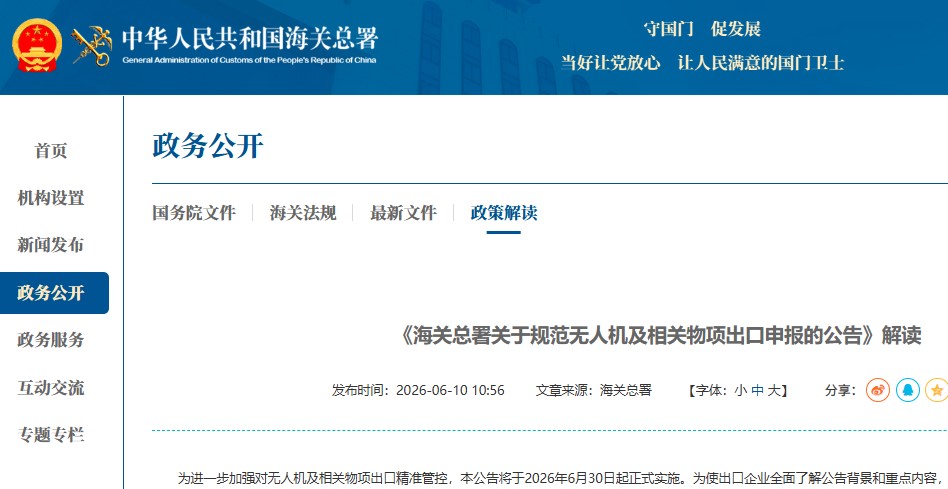
I. Do you need a license? The answer: it depends on parameters, not on usage
Many companies mistakenly believe that consumer or agricultural drones are “civilian” and therefore do not require a license. This is a serious misconception.
Under the Export Control Law, the Regulations on Export Control of Dual-Use Items, and the 2026 Dual-Use Items Control Catalogue published by Announcement No. 91 of 2025 of the Ministry of Commerce and the General Administration of Customs, drone export controls are based on technical specifications – not on the intended use. Agricultural, aerial photography, or consumer drones must obtain a license if their parameters meet the control thresholds.
China applies a dual control system:
- 1. Military-use drones (e.g. reconnaissance, attack) → require a Military Export License;
- 2. Civilian drones (and their supporting payloads and components) that meet the technical parameters → require a Dual-Use Item and Technology Export License.
II. What is covered? Six categories checked one by one
According to the Export Control List of Dual-Use Items of the People’s Republic of China and the Catalogue for the Administration of Import and Export Licenses for Dual-Use Items and Technologies (2026 Edition), the control scope for drones and related items covers six major categories, each with clear technical thresholds.
(1) Complete drones
Drone exports are covered by two core control codes – 9A012 and 9A501 in the Dual-Use Export Control List. An unmanned aerial vehicle (including unmanned airships) falls under control if it meets any one of the following technical parameters:
| Parameter condition | Specific standard |
|---|---|
| Endurance condition 1 | Maximum endurance between 30 minutes (inclusive) and 1 hour, and capable of stable take-off and controllable flight under wind gusts of 46.3 km/h (25 knots) or above |
| Endurance condition 2 | Maximum endurance equal to or greater than 1 hour |
| Range | Range equal to or greater than 300 km (corresponding to control code 9A501) |
| Dissemination system | Equipped with, or designed to be equipped with, an aerosol dissemination system of 20 litres or more, and capable of autonomous flight or beyond-visual-range (BVR) control |
| Engine | Fitted with a dedicated aviation engine with a maximum continuous power output exceeding 16 kW |
Exemption note: Model aircraft designed exclusively for entertainment or competition are not subject to the full 9A501 controls. However, if such models are modified to meet any of the above parameters, they will require a license.
(2) Dedicated payloads
High-performance payloads specially designed for controlled UAVs are separately listed in the control catalogue because they can directly enhance military reconnaissance, target acquisition, or precision strike capabilities. Whether exported separately or together with the complete drone, they may not be exported without a license.
The four core controlled types are:
- Infrared imaging equipment: operating wavelength between 780 nm and 30,000 nm, and instantaneous field of view (IFOV) less than 2.5 milliradians;
- Synthetic aperture radar (SAR): operating range exceeding 5 km, with a strip-mode resolution better than 0.3 m, or a spotlight-mode resolution better than 0.1 m;
- Target designator lasers: capable of stable operation at temperatures above 55 °C, non-temperature-controlled type, with single-pulse energy >80 mJ, stability better than 15%, and beam divergence <0.3 milliradians;
- High-precision inertial measurement equipment: heading accuracy <2 degrees, attitude accuracy <0.5 degrees, and resolution <0.1 degree.
(3) Core components
Core components that can be directly used to modify or assemble controlled UAVs, or to enhance their critical performance, are included in the 2026 control list. The 2026 edition newly adds “equipment and components specially designed to modify manned aircraft into controlled UAVs” to the control scope.
Regularly controlled core components include:
- Dedicated aviation engines with maximum continuous power exceeding 16 kW;
- High-precision flight control autopilots;
- Gyroscopes and related components.
(4) Counter-UAV equipment
Civil counter-UAV systems have been included in the export declaration scope for UAV-related items. Exporters must comply with the declaration requirements of Announcement No. 78 of 2026 by the General Administration of Customs. It should be noted that Announcement No. 78 primarily standardises export declaration procedures (such as filling in the “restricted/controlled goods identification code” and “declaration elements for restricted/controlled goods”) – it does not by itself establish the control status. Whether a counter-UAV device is a controlled item must still be determined against the specific technical thresholds in the Export Control List of Dual-Use Items.
(5) Special scenario controls
Even if a drone is not listed in the control catalogue, export is prohibited if the exporter knows or should know that the goods will be used for weapons of mass destruction proliferation, terrorist activities, or military purposes.
(6) Country-specific controls
Announcement No. 46 of 2024 by the Ministry of Commerce explicitly states: the export of dual-use items to US military end-users or for US military end-uses is prohibited. In principle, exports of gallium, germanium, antimony, and superhard-material-related dual-use items to the US are not permitted; for graphite dual-use items, stricter end-user and end-use reviews apply.
III. Five-step self-check (Remember: license first, ship later)
Step 1: Check your product against the control list
First, compare your product’s technical parameters against the Export Control List of Dual-Use Items of the People’s Republic of China and the Catalogue for the Administration of Import and Export Licenses for Dual-Use Items and Technologies (2026 Edition).
Key checkpoints: endurance, wind resistance, control range, whether special payloads are carried, range, etc. HS codes are for customs reference only and are not decisive – the need for a license is determined by the actual technical parameters of the product.
Special note: HS codes are classified by maximum take-off weight, while export control codes use entirely different technical criteria. Two drones with the same take-off weight may fall under different control codes due to endurance differences; conversely, two drones with very different take-off weights may fall under the same control code.
Step 2: Assess the end-user and end-use
To determine whether a product is controlled, companies must not rely solely on the control list and catalogue – they must also conduct a thorough end-user and end-use review. Some items that do not meet the listed technical thresholds may still fall under control based on specific end-use or end-user circumstances.
Step 3: If uncertain, proactively consult
If you are unable to determine whether your intended export is a controlled item, you may submit a consultation request through the “Dual-Use Items and Technology Import/Export Approval” section on the Ministry of Commerce’s online government service portal. When requesting consultation, you should provide the performance specifications, main uses, and the reasons why you cannot determine the controlled status.
Step 4: If controlled, apply for a license
Once an item is confirmed to be controlled, the exporter must apply to the Ministry of Commerce through the provincial commerce authority, fill in the application form for dual-use items and technology export, and submit the required documents. A license is required before any export, transfer, or cross-border delivery of dual-use items.
Practical note: If a single order includes multiple models that fall under different control codes (e.g., an industrial drone under 9A012 and an agricultural drone under 9A501), you must apply for separate licenses for each control code – they cannot be combined. When a drone carries a detachable controlled payload, the drone and the payload must also be licensed separately.
Step 5: Declare truthfully to customs
According to Announcement No. 78 of 2026 by the General Administration of Customs (effective from 30 June 2026), exporters must declare truthfully to customs. For controlled items, the “Remarks” column of the customs declaration must state “This is an export-controlled item” and list the corresponding dual-use export control code. For items that are not controlled but whose characteristics are close to the thresholds, the “Remarks” column should state “This is not an export-controlled item.”
Exporters must also follow the prompts in the “Single Window” system to fill in the “restricted/controlled goods identification code” and “declaration elements for restricted/controlled goods” with the specific technical indicators.
IV. How serious are the consequences? Do not take any chances
Enforcement by customs and commerce authorities on dual-use items has been intensifying. Cases of illegal dual-use exports are rising rapidly, and among them, cases involving drones and their components have increased significantly.
Administrative penalties: Exporting controlled items without a license is subject to fines under Article 34 of the Export Control Law. In practice, there have been cases where companies used cross-border e-commerce (e.g., 9610 mode) to export controlled items and were penalised even when the illegal turnover was only around RMB 20,000.
Criminal liability: If an exporter intentionally exports controlled drones without a license and the value exceeds RMB 200,000, it may constitute the crime of smuggling goods prohibited from import/export, punishable by up to five years of imprisonment or detention, with or without a fine; if the value exceeds RMB 1 million or if there are other aggravating circumstances, the penalty may be five years or more imprisonment, plus a fine.
Important: Entrusting a freight forwarder or supply chain company to handle customs clearance does not exempt the exporter from its compliance responsibilities. The exporter must clearly inform the agent of the controlled status, review the declaration content, and never adopt a “just let the forwarder handle it” attitude.
V. Compliance summary for enterprises
1. Determine the control status before accepting an order – do not rely on past experience; check not only 9A012 but also 9A501.
2. Establish a closed-loop process of “parameter verification → end-user review → compliance approval”.
3. If parameters are in doubt, consult the Ministry of Commerce proactively – never ship blindly.
4. Never circumvent controls by splitting shipments or misdeclaring product names.
5. For complex orders involving multiple models or complete drones with payloads, plan your license split strategy in advance.
Compliance is not a burden – it is a safeguard for long-term business growth. In the context of increasingly stringent global dual-use controls, building a robust export compliance system is the fundamental path for drone exporters to achieve sustainable success.
Post time: Jul-15-2026