
Many foreign trade business owners and finance professionals have fallen into this trap: goods cleared customs smoothly, shipped normally, and full payment was received — a seemingly perfect transaction, yet the export tax refund gets delayed, stuck, triggers an investigation, or is even outright denied!
People often think tax authorities are being too strict. But the real root cause — which few truly understand — is this:
Customs review: Lenient; only checks for customs clearance compliance.
Tax authority review: Extremely rigorous; compares every single document character by character.
Over 80% of tax refund issues stem from incorrectly filled customs declarations!
A tax refund failure is almost never due to the transaction being fake — it’s almost always errors or omissions in document details, mismatched fields, or inconsistencies in the “four-flow” chain.
Core Focus: 12 Key Customs Declaration Fields You Must Monitor for Tax Refunds
Customs declarations contain many fields, and customs rarely scrutinizes each one in detail. However, the tax authority’s system performs automated, character-by-character comparisons with zero tolerance for errors. A single mistake in any of the following 12 fields puts your entire tax refund application at high risk!
Entity Information Fields
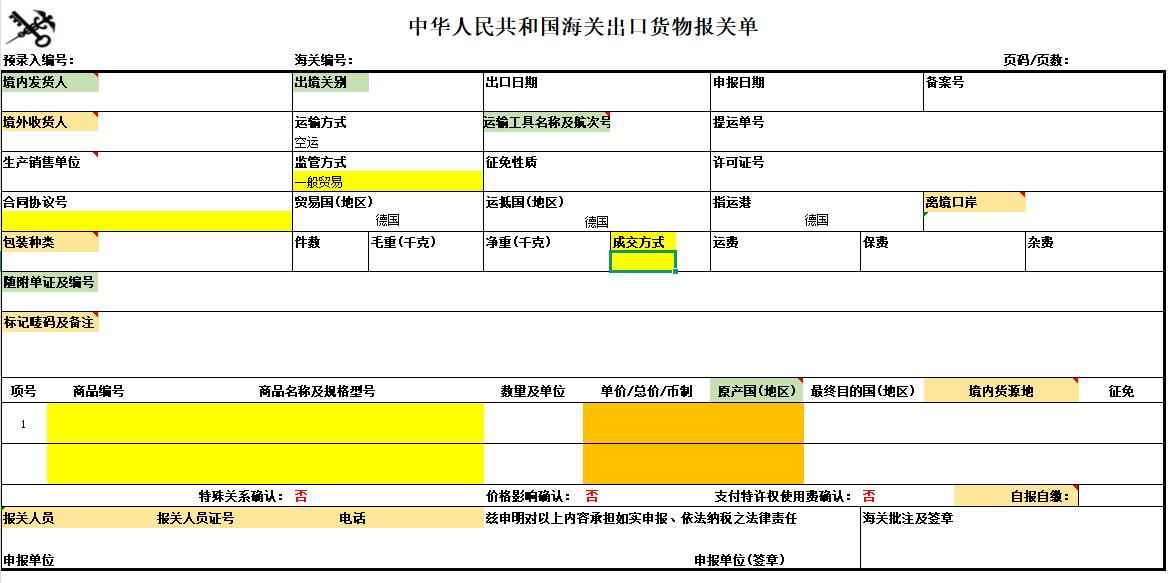
- 1. Domestic Consignor / Exporter: Must be filled with the actual tax-refund applicant’s own name. Never fill in a freight forwarder or supply chain company.
- 2. Overseas Consignee / Buyer: Must match the foreign sales contract buyer and align with the paying entity.
- 3. Producer / Manufacturer: Trading enterprises must fill in the full name of the actual domestic supplier (factory). This is a key basis for verifying supply authenticity.
Time & Regulatory Fields
- 4. Export Date: The sole standard for tax refund deadlines. Avoid cross-year declarations that cause forfeiture.
- 5. Trade Method: Ensure correct classification (e.g., 0110 General Trade). Selecting the wrong method leads to automatic rejection.
- 6. Domestic Place of Origin: Must match the supplier’s invoice location to avoid a 100% trigger of tax investigation.
Product Matching & Price Fields
- 7-9. HS Code, Product Name, Quantity: Must match VAT input invoices character by character. Never “choose the higher rate” for HS codes.
- 10-12. Terms, Currency, Remarks: Tax refunds only recognize FOB prices. Ensure payment records match the declared FOB amount.
Pitfall Avoidance Guide: 8 Common Tax Refund Mistakes
Robust Risk Control: “Four-Flow” Consistency
Document Flow + Goods Flow + Invoice Flow + Fund Flow = Zero-Risk Tax Refund
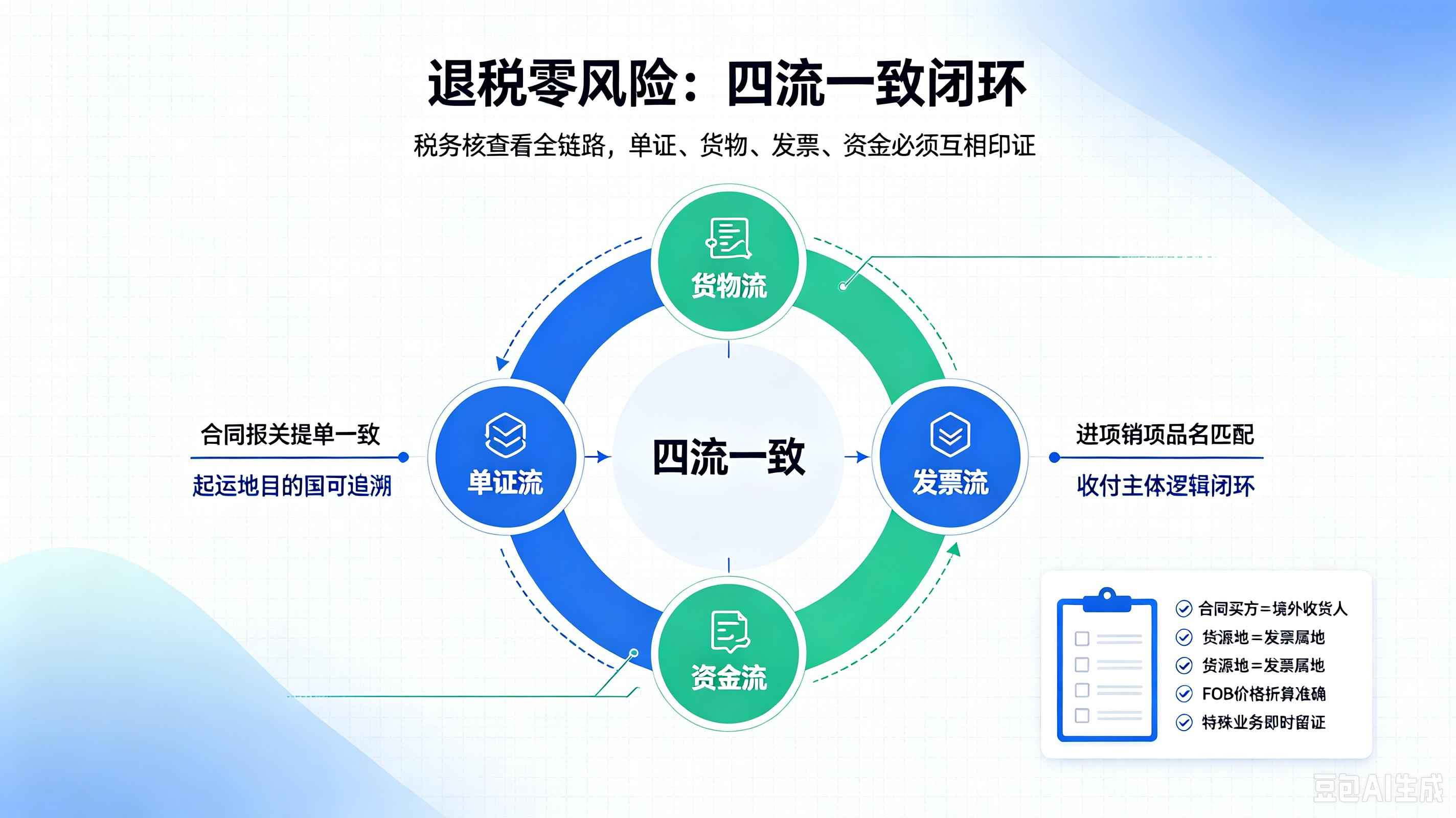
Tax refund audits never look at a single customs declaration in isolation — they trace the entire chain of transactions to verify business authenticity. As long as the four flows are consistent and evidence is complete, your application will pass any level of review!
Document Flow — The Foundation of Business Authenticity
Documents to retain: Domestic and foreign sales contracts, customs declarations, bills of lading (sea/air), and customs clearance authorization agreements.
Goods Flow — The Core Focus of Tax Authority Audits in 2026
Documents to retain: Supplier’s delivery order, domestic transportation tracking documents, loading list, and international logistics bill of lading.
Invoice Flow — Rigorous Automated Comparison
Input side: VAT special invoices must have product names, specifications, and quantities that closely match the customs declaration.
Export side: The buyer information on the export invoice must match the customs-declared overseas consignee. Avoid vague invoicing or generalized abbreviations.
Fund Flow — Eliminate Abnormal Payment Risks
- Regular transactions: The payment recipient and payer must correspond one-to-one with the contract and invoice parties.
- Special transactions: For all tripartite collections or payments, secure a stamped tripartite agreement + business explanation immediately at the time of the transaction. Never create supplementary documents after the fact.
Implementation Process — A Zero-Risk Tax Refund Execution Plan
- Dual-review before customs declaration: Have both the logistics/customs team and the finance team cross-check the 12 key fields, aligning contract and invoice information, before submitting the declaration.
- Document immediately in case of exceptions: For special circumstances such as tripartite payments, over/under-shipment, or delayed payment collection, compile explanations and supporting evidence on the spot.
- Complete documentation before applying for the tax refund: Electronically archive the entire set of four-flow documents (keep for 10 years). Complete this before submitting the tax refund application, so documents are ready for inspection at any time.
- Monthly self-audit per shipment: Cross-check each transaction’s customs declaration, input invoices, payment collection records, and logistics bills of lading to identify any anomalies.
The core risk in export tax refunds is never the inauthenticity of the business itself, but rather irregular documentation and an incomplete chain of evidence.
Customs clearance only marks the end of the customs process. A compliant customs declaration is the key to ensuring your tax refund arrives smoothly.
Pay close attention to the 12 key fields, avoid the 8 high-risk pitfalls, and maintain a closed-loop four-flow control system — and you will completely eliminate the problems of delayed refunds, investigations, and denied claims!
Post time: Sep-10-2026