
I. Not a Full Tariff Cut, but Highly Significant in Signal
Key facts of the latest China-U.S. tariff policy adjustment:
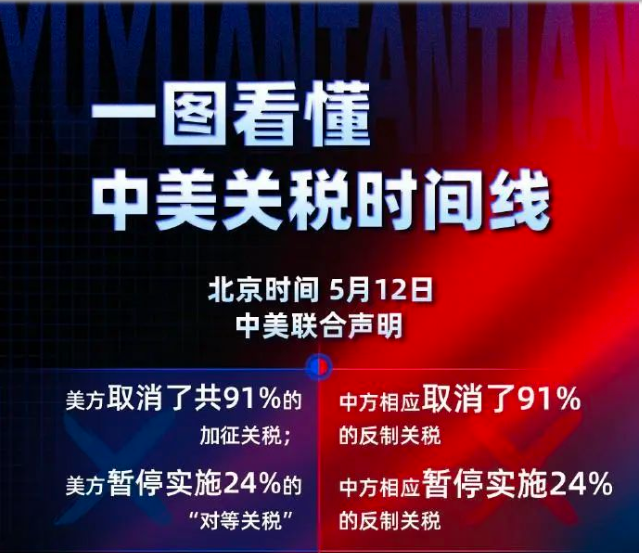
| Item | Details | Source |
|---|---|---|
| Policy agreement date | Joint statement released on May 12, 2025 | China’s Ministry of Commerce, Xinhua News |
| U.S. tariffs removed | 91% of additional tariffs canceled | Officially confirmed |
| China’s counter-tariffs removed | 91% of counter-tariffs canceled | Officially confirmed |
| U.S. “reciprocal tariffs” suspended | 24% suspended for 90 days | Officially confirmed |
| China’s counter-tariffs suspended | 24% suspended for 90 days | Officially confirmed |
| Tariffs retained | 10% baseline tariff retained by both sides | Officially confirmed |
| Section 301 tariffs on non-sensitive categories | Reduced from 25% to 7.5% | Further verification needed |
| 1,200 new tariff lines exempted | Overall scale announced, full list pending | Partially confirmed |
| $800 de minimis exemption elimination | Awaiting official confirmation | To be verified |
| Effective date | To be determined based on final MOFCOM announcement | Pending |
Important note: The full list of “1,200 tariff lines” and the official “effective June 1″ announcement have not yet been released through public channels. It is recommended to rely on final announcements from China’s Ministry of Commerce (www.mofcom.gov.cn) and the U.S. USTR website.
Although the policy adjustment is limited in scope, market expectations have already moved ahead. For the international logistics industry and foreign trade exporters, this still represents a critical window for structural order restructuring and cost optimization. The window is tentatively set at 90 days.
II. Impact on Logistics Companies: Short-Term Capacity Tightness, Long-Term Restocking Logic Reshaped
Based on industry feedback, the market response to the policy dividend has already begun to emerge:
A clear increase in foreign trade inquiries and orders, tightening U.S.-bound capacity
Following the policy news, some industry sectors have reported a significant increase in U.S. customer inquiries and orders, reflected in:
- Rising booking volumes for U.S. West Coast and East Coast sea freight, with capacity becoming tight
- Fluctuating air freight demand for high-value electronics, auto parts, and other categories
- Increased demand for tariff classification declarations, adding pressure on customs brokerage and clearance
Rising demand for overseas warehousing as a key service capability
Due to changing direct shipping costs, some cross-border sellers are evaluating a shift to overseas warehousing models. Currently, inbound volumes to overseas warehouses around major ports such as Los Angeles, New York, and Dallas have seen significant year-over-year growth, with some popular locations experiencing queues.
For the logistics industry, this means:
- Continued growth in demand for full-container load (FCL) shipments for U.S.-bound head haul
- Warehouse capacity and turnover efficiency becoming core competitive advantages in serving clients
- Securing capacity and overseas warehouse resources in advance becoming an important strategy
Logistics services must upgrade to respond
- Timely follow-up on officially released tariff line lists to help clients identify tariff dividend opportunities
- Provide one-stop logistics solutions combining “tariff optimization + head-haul ocean freight + overseas warehousing”
- Provide real-time alerts on U.S. West Coast port congestion, capacity, and freight rate fluctuations
III. Impact on Clients – Analysis by Four Client Types
Based on the latest tariff policy and market changes, clients fall into four main categories:
Category 1: Direct Beneficiaries
Products are on the exemption list, covering popular categories such as furniture, auto parts, electronics:
- Lower tariff costs, potential increase in export profits
- Increased willingness of U.S. buyers to place supplemental orders and build inventory
Category 2: Indirect Beneficiaries Along the Industrial Chain
Products are not on the exemption list, but the company supplies parts, supporting packaging, production equipment, etc., to benefiting industries:
- Lower costs for downstream exporters and increased orders may drive upstream supply chain demand
Category 3: Cross-Border Sellers Reliant on Small-Package Direct Shipping
Due to changes in direct shipping costs (the elimination of the $800 de minimis exemption awaits official confirmation), profit margins for traditional small-package models may be squeezed.
Category 4: Companies with Highly Sensitive, Non-Exempted Categories
Certain high-end machinery, specific electronics, specialty materials, etc., not covered by this tariff adjustment:
- Weakened price competitiveness in foreign trade
- Risk of overseas buyers diverting supply chains to third countries
IV. The Window Has Arrived: Dividends Are Here – Are You Ready?
1) Tariff Dividend: Targeted Benefit for Specific Categories
Although the policy covers a limited scope, it precisely targets essential foreign trade goods, high-value products, and high-export-volume categories. Tariff reductions will directly enhance the price competitiveness of relevant Chinese products in the U.S. market.
2) Logistics Industry Dividend: Moving from Price Competition to Value Competition
With rising shipment volumes, tightening capacity, and growing demand for overseas warehousing, the logistics industry is entering a value-competitive phase focused on capacity resources, schedule reliability, and professional solutions. Logistics providers with U.S.-bound capacity, quality overseas warehouses, and professional customs clearance integration capabilities will become the preferred partners for foreign trade clients.
3) Action Recommendations for All Foreign Trade Clients
Immediately verify your product HS codes to see if they are on the published exemption list
Re-plan your second-half shipment schedules – assess the feasibility of consolidating small orders into full containers, securing capacity early, and deploying overseas warehousing
Choose a logistics partner with capacity guarantee, overseas warehouse resources, professional customs clearance, and end-to-end visibility
Post time: May-27-2026